

|
|
|
|
THE OPENING OF THE GUGGENHEIM MUSEUM IN BILBAO  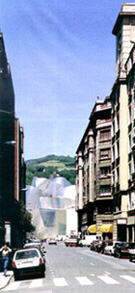 As of October the 19th, a new Guggenheim Museum exists in Bilbao. This major project was initiated in 1991 and completed as a result of two desires: one on the side of the Basque government which wants to revive the city of Bilbao; the other, on the side of the Guggenheim Foundation which wanted to increase its activities in Europe. An investment of 100 million American dollars was necessary for the construction of the museum. The Basque government is involved in the financing of the project and the management of the museum. The Guggenheim Foundation, on the other hand, takes care of the exhibition programming and the new acquisitions. The scale of this project, as well as its architectural quality have already provoked much interest. In fact, the Guggenheim Museum in Bilbao is certainly one of the big accomplishements in the museum field of the past few years.
For a long time, the activities of the Guggenheim Foundation were divided between the Solomon R. Guggenheim Museum, situated in the building on 5th avenue in New York, across from Central Park, and the Peggy Guggenheim collection in the palace Veneir dei Leoni, situated on the Grand Canal in Venice. Thus, in the last ten years, the idea of the Guggenheim has changed to a great extent. The new vision of the museum coincides with the arrival of Thomas Krens, who was appointed director of the Foundation in 1988. He breathed into this international museum a new direction which is remarkably dynamic. In fact, the transformations are countless. First, in 1992, the Solomon R. Guggenheim Museum reopened after some significant renovations and increased its activities with the new branch in SoHo. Next, in 1995, improvements of the exhibition halls and the gardens of the museum in Venice were effectuated. Finally, last month, hardly a few weeks after the opening of the museum in Bilbao, the Guggenheim Foundation opened a new exhibition space in Berlin, the Deutsche Guggenheim Berlin, thanks to the collaboration and the financial support of Deutsche Bank.
More than once, as in the case of the Solomon R. Guggenheim Museum in New York, the architecture of the museum in Bilbao was qualified as a work of art in itself. Many commentaries underline the similarities between these two buildings: their organic form, their remarkable and daring appearance. An article by Herbert Muschamp, the architectural critic for The New York Times, is available on the Internet. It discusses the many qualities of this architectural project. The silhouette and the materials of the Guggenheim museum in Bilbao evokes the industrial environment in which it is situated, while distinguishing itself as a unique structure. The project represents one of the most significant initiatives in the development of Bilbao. In the next few years, a new subway, an airport and many other buildings will be constructed in the area of the museum.
Sylvie Parent
|
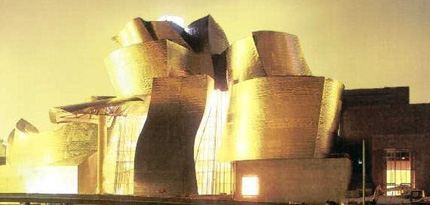
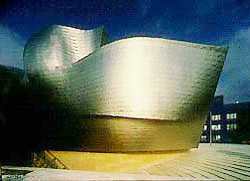 Already operating between Europe and America, the Guggenheim Foundation has achieved a greater concentration of its activities in the original museums and at the same time, it has developed new contacts between the two continents through the creation of these recently opened institutions. Each time, the changes have taken the form of a major and innovative architectural project which become emblematic. As such, the new Guggenheim Museum in Bilbao is exemplary for it inscribes itself in the line of the museum in New York created by Frank Lloyd Wright. As a result of an international competition, it is the project of the architect and designer
 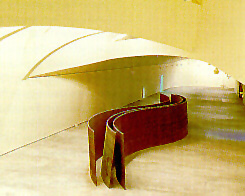 The Guggenheim Museum in Bilbao has a